


How we work
Built for White-Label WCAG Delivery
Automated + manual testing
Ticket-ready handoff
Verification after fixes (NVDA/VoiceOver)
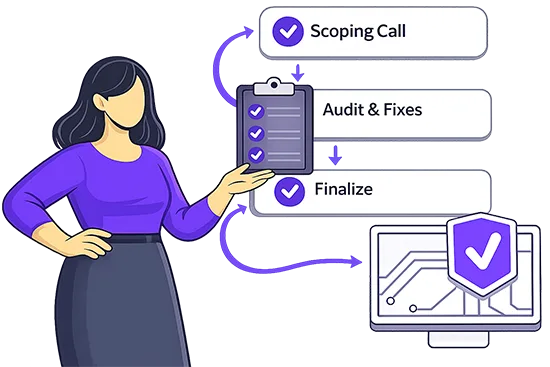
Built for agency workflows
Our role in your delivery
We work as your white-label accessibility partner — quietly and reliably.
- We operate under your brand
- You stay client-facing
- We support your delivery — not replace it
- Auto + manual testing — screen readers across Windows, iOS and Android
- Audits can be delivered as standalone engagements.
You own the client. We deliver accessibility.
Typical engagement flow
Most agencies follow this path.

Audit first
Audit-only delivery available.
- One-off WCAG Audit (EU-aligned)
- Risk- and priority-based findings
- Client-ready outputs

Targeted Remediation
- Clearly scoped remediation
- Priority-driven fixes
- WordPress and documents

Ongoing Compliance
- Retainer if needed
- Ongoing checks and updates
- Client-shareable status reports

Fits your workflow
How We Integrate With Agencies
- Work with your single point of contact (PM or tech lead)
- Deliverables in your format and tools (Jira/Asana/Trello/ClickUp/Sheets…)
- Clear ownership and handover
No new processes. No extra meetings. No unnecessary tooling.
Client-ready delivery, end to end.
How Delivery Looks in Practice
Delivery for remediation and ongoing engagements.
- Delivery-ready documentation
- Clear ownership and handover
- Fix-ready implementation details
- Verification after fixes
- Status you can confidently share with clients
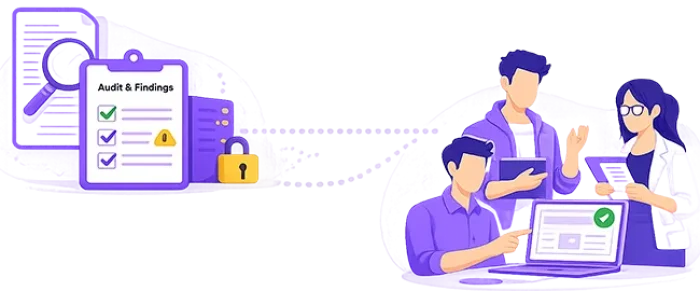
Everything needed to start delivery.
What we need to get Started
Requirements to start delivery smoothly.
- Access to staging or production
- Key templates or page types
- Named PM / tech lead
- Agreed scope and priorities
- (Optional) WordPress access for remediation

Quick answers for agency delivery.
Agency FAQ

Yes—white-label is the default.
NDA if needed. No subcontractor exposure. Deliverables can be branded as yours. To the client, it’s your agency delivering.
Only if you want us to. By default: no.
If you prefer “co-pilot mode,” we can join a call as your technical accessibility specialist under your lead—without taking over the relationship.
A balanced approach:
automated checks (coverage)
manual QA (real issues)
screen reader testing where it matters (real-world usability)
Goal: practical accessibility that holds up in real use—not checkbox compliance.
We retest changes (automated + manual) and document results. You get confirmation of what’s fixed, what remains, and any known limitations.
Yes—this is where it works best.
A retainer gives you predictable capacity, priority support, and client-ready status updates. You get an accessibility capability without hiring.
We prioritize based on:
user impact (blockers)
compliance risk (critical failures)
effort vs benefit (quick wins)
This keeps projects moving and makes progress easy to communicate to clients.
Minimal input:
staging/production access (or link)
key templates/pages (or sitemap)
your PM/tech lead contact
if WP remediation: agreed access level + scope
No big onboarding, no heavy setup.
Typically:
Client-ready audit report (PDF/DOCX)
Fix list: Sheets, Jira, Asana, Trello, ClickUp...
Verification checklist + sign-off notes
Optional dev notes/snippets where it helps
Everything is designed so you can confidently forward it to your client.
We work directly with your PM or tech lead. You stay client-facing. We operate as the delivery layer in the background—clear owners, fewer blockers, faster execution.
No. We fit into your existing workflow.
Sheets, Jira, Asana, Trello, ClickUp... whatever you already use. No new ceremonies, no “accessibility standups,” no unnecessary tooling.
We don’t deliver “WCAG theory.” We deliver fix-ready tasks:
page/template or component
selector or clear location
what’s wrong + why (WCAG reference)
recommended fix (practical)
priority + definition of done
Your devs can open a ticket and implement immediately.
Both.
Audits: for any website/stack.
Remediation: often implemented directly in WordPress (fixes or a compliant rebuild), because we can ship quickly and safely when we control the environment.
We operate with a “proof mindset”:
retest after fixes
track status per item (fixed / partial / won’t fix + reason)
map to WCAG criteria for traceability
So you can show real progress—not just claims.
We prevent it with clear scope upfront (pages/templates/components).
If the client adds more, it becomes a change request—you stay in control, and we give a clean estimate and next step.
Fast, because we don’t require process changes.
We typically need: a staging/production link, your priority list, and your preferred ticket format. Then we move into delivery mode.